
Discussion guide for ‘Either the Beginning or the End of the World’
About the book
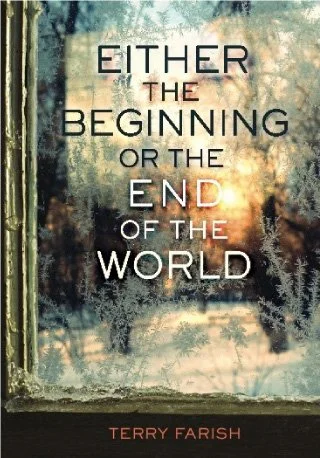
Sofie, the daughter of a Cambodian immigrant and a hardscrabble fisherman, falls into a forbidden love with Luke, a young army medic back from Afghanistan. Raised by her father alone on the New Hampshire Seacoast, she "grew up a tall Scottish girl – my father’s side – who chanced to have Cambodian eyes.” Sofie feels rage but also an aching she wishes she could outgrow for her Cambodian mother who has been absent and unreliable much of her life. With the soldier, Sofie journeys into the story of her own family’s experience of war. “I don’t want you for ancestors. I don’t want that story," she tells her mother when she listens to the truth of Cambodia’s Khmer Rouge regime. But it flashes bright, like a monk’s saffron-colored robe in New Hampshire snow. Through Cambodian myth, ocean lore of a fisherman’s family, and the awe of love she and Luke have for one another, Sofie is drawn into extraordinary worlds she had not imagined and a new sense of her own identity as an American girl.
Themes
PTSD across generations
Cambodian-Americans
U.S. Army veterans
Search for identity
The Khmer Rouge Regime in Cambodia, 1975–79
Mothers and daughters
Grandmothers and granddaughters
Fathers and daughters
Immigrants and refugees
Commercial fishing in New England
New Hampshire Seacoast
The power of love to heal
Background
Khmer Rouge Regime
Between 1975 and 1979, Cambodian revolutionary commander Pol Pot and his army, the Khmer Rouge, sought to purge Cambodia of the educated, the wealthy, the professional classes, and all foreign influences in order to create a pure Communist peasant society. To achieve this society, families were evacuated at gunpoint from the capital Phnom Penh and other cities. They were marched into forests and country areas where they became slave laborers in the rice fields, but they were not allowed to eat the crops they cultivated; the Khmer Rouge forbade them more than an extremely limited ration of rice that could not sustain life. The Khmer Rouge committed terrible acts against their fellow countrymen, including torture, murder, starvation and rape. Approximately 1.7 million Cambodian people died, which accounted for nearly a quarter of the population.
PTSD and the Cambodian experience
Post-traumatic stress disorder is a mental health condition that arises after a terrifying experience. Symptoms can include emotional numbness, violence, depression and extreme anxiety. Many survivors of the Khmer Rouge regime developed PTSD because of the atrocities they witnessed or were forced to participate in. However, stigma around mental illness in the Cambodian community and survivors’ reluctance to openly talk about their experiences has made this condition difficult to identify and treat. PTSD causes suffering not only to family members who survived the genocide, but also to their children and grandchildren born in Cambodia and countries like the United States where Cambodians sought refuge. Sam Keo, a California clinical psychologist who treats Cambodian Americans, writes, “They witness their parents’ reactions and internalize these as if they were their own. The horrors of war do not end with the refugees, but they continue to be lived by their children and their children’s children.”
Discussion questions
Sofie is the daughter of a Scottish-American fisherman and Cambodian-American mom. She says, “I grew up and became a tall Scottish girl — my father’s side — who chanced to have Cambodian eyes.” Have you ever felt connected to two different groups, communities or cultures? Was it difficult to be connected to both at the same time? Did you choose one at one point in your life?
“Either the Beginning or the End of the World” is a story about a girl’s exploration of her identity, who she is as an American girl. At one time, the author had a working title for the novel, “An American Girl.” What discoveries do you think Sofie makes about her identity? What makes you uniquely American?
The love affair between Sofie and the returned soldier, Luke, is forbidden by her father. But circumstance and the emotional draw between them open the way for them to meet and fall in love. Why do her parents forbid her to see Luke? How does their love help Luke? How does it help Sofie?
When Sofie illegally sells some of her father’s shrimp, Johnny becomes enraged and shouts, “Do you know there’s not a breath a fisherman takes that doesn’t have a law attached to it?” What is happening to the fishing industry on the New Hampshire Seacoast? How do you think people’s work lives affect their families? Do you know of other lines of work that have gone through transitions? How have these transitions affected the lives of families?
Studies have recognized that PTSD is an emotional state that can be passed down through generations. Both Yiey, Sofie’s grandmother, and Lydia, her mother, are survivors of the Pol Pot Regime in Cambodia. What do you think Sofie’s grandmother helps her understand about their experience in Cambodia? How does her family’s PTSD affect Sofie?
Many refugees and immigrants come to the United States from very difficult political and economic situations. Vast numbers of new Americans show resilience, and surviving their hardships has given them skills to build their lives. What do you think can support people to best recover from trauma and loss and rebuild their lives?
When did you and your ancestors come to the United States? Do you see anything about the relationships between children, parents and grandparents across cultures that are similar to Sofie’s relationships with her mother and grandmother?
Both Yiey and Luke have been emotionally injured by their experience of war. Though Yiey is impacted by memories from Cambodia in the 1970s and Luke is impacted by memories of the war he recently left in Afghanistan, they understand each other’s fear very well. How do you think Yiey helps Luke begin to deal with his PTSD?
A recurring reference in the book is to the image of the rabbit in the moon. Yiey tells a Cambodian myth of the “Rabbit in the Moon” in which the rabbit represents immortality. Why do you think she told the tale, and what does it imply for Sofie and for Luke?
Author Amit Majmudar says, “The true meeting takes place when the book opens, and a stranger reads about — and comprehends — a stranger.” How have you “met” the Cambodian-American experience and the experience of veterans with this novel?
Reviews
“Farish’s writing is haunting. Beautifully written and briskly paced… An excellent choice for readers seeking a less than neatly packaged love story or a glimpse into the complicated lineage of war-torn areas.”
— Starred Review, School Library Journal
“The storytelling here has the logic of a dream, condensing the realistic moments of Sofie’s days, her grandmother’s heartbreaking memories, her mother’s fears, and Luke’s compelling need into interlaced metaphors that help Sofie sort out her complicated feelings while still leaving tantalizing gaps for readers to fill in.”— The Bulletin of the Center for Children’s Books
“Terry Farish’s stories about refugees and immigrants have been informed by her extensive work with the Red Cross in Vietnam, and you can feel that raw, authentic care given to her characters in EITHER THE BEGINNING OR END OF THE WORLD. It’s a love story, but it’s also a story of generations of a family, each affected by war and loss in their own ways.”
— Bustle
“… examines the intersections of love and war in a family’s history.”
— Booklist
“Farish has written a thoughtful and lyrical novel. Teens desiring a higher work of literature will not be disappointed while reading this. Issues of cultural identity, post-traumatic stress disorder, and what defines love are addressed in this work fit for the high school and beyond audience.”
— VOYA
Playlists
The following are the songs on author Terry Farish’s playlist for the novel. These musicians capture the feel of the novel and the experience of Sofie’s generation of Cambodian-Americans.
Bochan is a Cambodian-American singer from Oakland, California. She draws on inspiration from her family’s musical history during the era of 1960s Cambodian psychedelic rock and adds her own contemporary hip-hop sound.
Dengue Fever is an L.A.-based Cambodian pop psychedelic band. The band formed when brothers Zac and Ethan Holzman found vintage Cambodian records and joined with Cambodian singer Chhom Nimol. They have since grown to a six-member band and toured around the world.
