
Discussion guide for ‘The Good Braider’
About the book
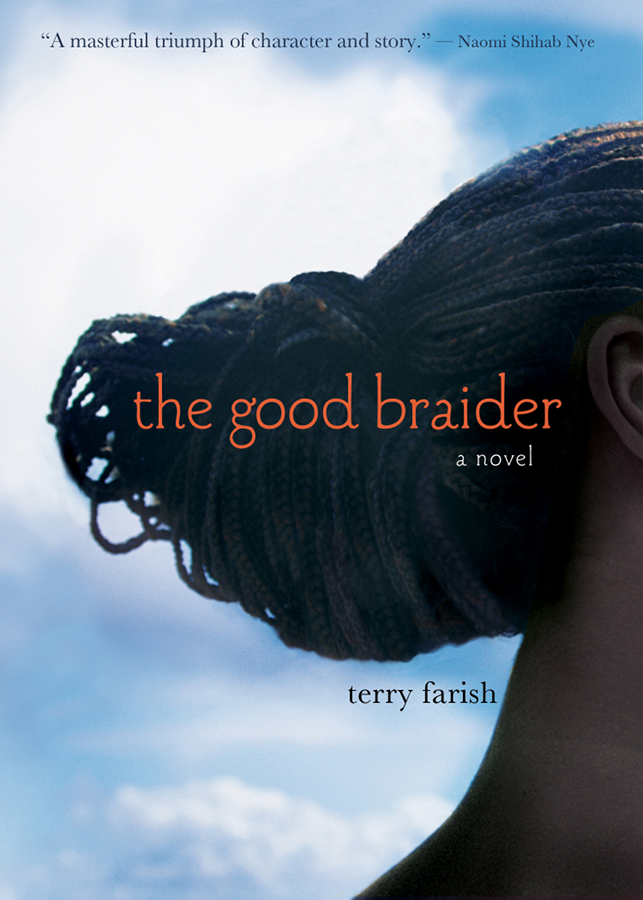
In spare free verse, Viola tells the story of her family’s journey from war-torn Sudan to Cairo and finally to Portland, Maine. Here, in the sometimes too close embrace of the local Southern Sudanese Community, she dreams of South Sudan while she tries to navigate the strange world of America — a world where a girl can wear a short skirt, get a tattoo or even date a boy; a world that puts her into sharp conflict with her traditional mother who, like Viola, is struggling to braid together the strands of a displaced life. “The Good Braider” is an intimate story of escape and survival, and also the universal tale of a young immigrant’s struggle to build a life on the cusp of two cultures.
Themes
Immigration and acculturation
Mothers and daughters
Displacement and refugee resettlement
Personal resilience
The power of education
Cross-group friendships
Cross-generational conflict
Rape as an act of war
Characters
Viola, a 17-year-old Sudanese American
Tereza, her mother
Francis, Viola’s little brother
Habuba, Viola’s grandmother
Gwendolyn, friend and neighbor in Juba, Sudan
Lokolumbe, Viola’s friend in Cairo
Poni, Viola’s friend in Portland
Jackie, Viola’s cousin whom she meets again in Portland
Lado, A South Sudanese friend who works at a Portland African restaurant
Mrs. Mejía, Viola’s ELL teacher
Andrew, Viola’s Irish-American friend who teaches her to drive
Discussion questions
“All men in Sudan will want to marry you,” Viola’s mother tells her in Part I of the novel. “You are a girl from Juba.” (p. 19) What do these lines tell you about Viola when you first meet her? How would you describe her relationship with her mother while they live in Sudan?
How does Viola and her mother’s relationship change once they are in the United States?
Were you surprised by the obstacles Viola and her mother faced once they were “safe” in America?
When Viola invites Andrew to her apartment, she realizes that her house is very “African” (pages 130–132). Look around your home; are there things that have been passed down or saved from your family or a former country?
Some scholars, such as Eric Reeves of Smith College, and journalists, such as Nicholas Kristoff of the New York Times, build a strong case for the responsibility of the United States to intervene to protect the people of South Sudan and Darfur from continuing aerial bombardments and atrocities from the Sudan Armed Forces. How do you see the U.S. role in Sudan?
“I am not doing well. I am not American. Or Sudanese. I am not in Sudan and not really in Maine. Or maybe I’m in both at the same time. I’m in some place I’m making up.” Viola is caught between two cultures and countries. Have you ever felt pulled strongly in two different directions?
What has Viola gained by coming to Portland, Maine as a refugee? What has she lost by leaving her home in Juba, South Sudan?
Viola’s mother allows her to spend time alone with Lokolumbe but is angry when she is alone with Andrew. Why does her mother view the two boys differently? Have you had a friendship or relationship with someone with a background very different from yours?
The poet Naomi Shihab Nye wrote about the main character, Viola: “You will never again encounter a refugee from anywhere without remembering Viola and her family.” Do you see similarities across cultures and time periods in refugees’ journeys to make a new country their home?
In many ways, Viola’s mother tells her daughter who she is. What do you remember your parents saying about you as a child? Do they still say it?
When did you or your ancestors come to the United States? Did you or they share any of Viola’s experiences of immigration?
Background
The novel opens in Juba, in southern Sudan, in 1999 during the decades-long war between the north and south of the country. The story is fiction, but set in the political context of the civil war. Viola and her family are southern Sudanese. People of southern Sudan identify with African cultures and practice tribal faiths and Christianity. The people of northern Sudan are predominantly Muslim and identify with Arab cultures. These two regions have been at war for more than fifty years. Two million people of the South were killed in the wars that the International Criminal Court identifies as genocide. The ICC issued a warrant of arrest for President of Sudan Omar al-Bashir for atrocities against the people of southern Sudan and the western region of Darfur. In 2005, al-Bashir and southern Sudanese rebel leader John Garang signed the Comprehensive Peace Accord, bringing an end for a time to direct conflict in the south. In 2011, South Sudan became an independent nation with Juba as the capital city. “The Good Braider” concludes in Portland, before the Peace Accord of 2005 is signed.
Even though South Sudan exists as an independent nation, the Sudanese Armed Forces atroci’ atrocities continue against civilians and humanitarian workers in Darfur and regions on the border between Sudan and South Sudan.
Resources
About Sudan
GoodBraider.com, “Researching South Sudan,” an annotated list of some of the sources used in writing the novel.
Internal Displacement Monitoring Center, “Sudan: A worsening displacement crisis in need of a comprehensive response.”
Sudanreeves Sudan Research, Analysis, and Advocacy, by Eric Reeves
About refugees
CAL Center for Applied Linguistics, improving communication through a better understanding of language and culture.
The Spring Institute for Intercultural Learning, The Receiving Communities Toolkit: A Guide for Engaging Mainstream America in Immigration IntegrationWelcoming America, a national grassroots-driven collaborative that works to promote mutual respect and cooperation between foreign-born and U.S.-born Americans.
On literacy and literature
Elephant Rag, a blog on multicultural literature for teens and children.
I’m Your Neighbor Books, a hub for using stories featuring immigrant cultures to build communities.
Story of a Pumpkin, which follows the New Hampshire Humanities Council Bhutanese Nepali Folktale Project.
Picturing Writing, by Beth Olshansky, who works with children, including immigrant children, to draw and write their stories and build literacy skills.
Celebrating the culture
Listen to the Congolese musician Koffi Olomide
Listen to the music of South Sudanese-American musician OD Bonny
Listen to “A Girl from Juba,” the music video OD Bonny created in honor of “The Good Braider,” which features settings from the novel in Portland, Cairo, and South Sudan.
Further reading
“Between Two Rivers,” by Aruna Kenyi
“Escape from Slavery,” by Francis Bok
“Home of the Brave,” by Katherine Applegate
“A Long Walk to Water,” by Linda Sue Park
“Making It Home: Real-life Stories from Children Forced to Flee,” with an introduction by Beverley Naidoo
“Of Beetles and Angels,” by Mawi Asgedon
“They Poured Fire on Us From the Sky,” by Benson Deng, Alephonsion Deng, and Benjamin Ajak
“War Child: A Child Soldier’s Story,” by Emmanuel Jal
“What Is the What,” by Dave Eggers
Awards
An American Library Association Best Book for Young Adults
Winner of The Boston Authors Club Young Reader Award
A School Library Journal Best Book of the Year
The Lupine Award presented by the Maine Library Association
A Bank Street College of Education Best Book of the Year
Georgia Peach Book Award Finalist
Reviews
“Like Max Bixler’s adult book, ‘The Lost Boys of Sudan,’ this powerful novel tells today’s refugee story .… An essential addition to the Booklist Core Collection feature, ‘The New Immigration Story.’”
— Hazel Rochman, Starred Review, Booklist“While Farish so lyrically and poignantly captures Viola’s wrenching experience leaving her home, navigating the waiting game of refugee life, and acculturating into the United States, she’s equally successful in teasing out sweet moments of friendship and universal teenage experiences. Viola’s memorable, affecting voice will go far to help students step outside of their own experience and walk a mile in another’s shoes.”
— Jill Heritage Maza, Starred Review, School Library Journal“Conceived over the course of 10 years, and drawing on ethnographic research conducted in local kitchens, living rooms, and Kennedy Park, this young-adult novel is a searing, stark, and ultimately hopeful account of what it means to be a young woman coming of age in a complicated world.”
— Portland Phoenix“Viola’s relationship with her mother is among the most complex themes of the book and will surely be among the most troubling for American readers. Viola begins very quietly to assert her independence, and when doing so causes her mother to act in a way most of us would deem unthinkable, she responds by calling the authorities. The incident highlights the enormous generational/culture clash many refugee families face here in America.”
— Concord Monitor“What makes a life better? And who is in control of defining what better means? Farish honestly illuminates a culture foreign to most Americans and sensitively addresses the complexities of American life for those outside the mainstream.”
— Washington Independent Review of Books“This is a story written with the power of an elephant. [Farish’s] spare words open your heart to grace and beauty.”
— The Pirate Tree: Social Justice and Children’s Literature
