• Writing a Picture Book

    Often in children’s books, the authenticity of emotion arises from the writer searching for and finding themselves as a child and their own fears and joys.

    Here are some elements of fiction to think about as you explore writing a picture book.

    I’ve come to realize that writing a book for children is a powerful act.  Consider your audience. They are young children who are soaking in everything that touches their lives. A book for a young child is the world. It’s how to see.  The book becomes part of making meaning for the very first time. So that’s what you’re doing when you write a story that is accessible to young children.

    Even though we’re creating books for the very youngest humans – and also because that’s what we’re doing – picture books are an art form with many possible layers to create meaning. Here I’m talking about the language in picture books, but I offer this focus on writing knowing that it’s the coming together of two art forms – words and images – that makes meaning for a child.

    There are almost as many kinds of picture books as there are writers, but I want to offer you a sampling of language writers have used in picture book stories to inspire possibilities for you.

    Julie Flett draws from a memory of a family ritual in her book Wild Berries. The arc of the story is the arc of a day of a grandmother and grandchild picking blueberries.  

    Flett creates an elegant and spare emotional tone in her words and images.  The language is a tool to build characterization – we begin to know the characters through this spare language.

    The is a bilingual story, and Flett weaves words in her own dialect of the Cree language through the telling. In the English edition of the book, Cree is printed using the Roman alphabet.  Flett devotes some of her few words to sounds.

             Tup, tup

    She has helped the reader meet the grandmother and grandchild using spare language.  She includes words in their mother language.  And she brings the reader into the sensory experience of picking berries in the language that a child might hear, and might like to repeat, tup, tup. 

    Bear Came Along written by Richard T. Morris, and illustrated by LeUyen Pham is a wild cumulative tale.

    A bear has got himself in a fix taking a raft down the river, and is joined by one animal after another. The animals’ plight gets worse until it gets even more worse, until all the animals on the raft are piled up at the edge of a giant falls like Niagara. A cliff hanger like this will delight a lot of kids. They will also see the danger the animals face and that is even more exciting.  Sometimes children love stories that scare them. You can read more about this idea in Jan Mark’s genius story collection for slightly older children, Nothing to Be Afraid Of.

    Subversive storiesmight not be considered auspicious by parents,” as one reviewer wrote about Jon Klassen’s This Is Not My Hat. There is a theft, a betrayal, and a likely killing of the main character, a little fish. The language is very direct.  Klassen begins,

    This is not my hat.  I stole it.

    Children love this book. And educators do too and have used it to teach about moral philosophy and ethics in which children talk about trust, lying, and theft.

    You might be interested in exploring fiction that takes readers back in history, possibly based on a life story. A family story can turn on a single concrete item of value to a family that becomes the thread for the reader to follow.

    Using a rope that children once used for a jump rope is the thread Jacqueline Woodson wove through This Is the Rope: A Story of the Great Migration illustrated by James Ransome. She tells this story in free verse. 

    This is the rope my grandmother found
    beneath an old tree
    a long time ago
    back home in South Carolina.
    This is the rope my grandmother skipped
    under the shade of a sweet-smelling pine.

    In Woodson’s author’s note, she described her own grandmother’s experience that brought her family from South Carolina to Brooklyn.  She understood deeply the story of her fictional characters. Often in children’s books, the authenticity of emotion arises from the writer searching for and finding themselves as a child and their own fears and joys.

    You can write dialogue that reveals a character through his speech. In my book, The Cat Who Liked Potato Soup, illustrated by Barry Root, the story turns on voice.   

    The omniscient narrator has the colloquial voice of the main character. It’s partly through his voice that I could help readers imagine the old man. And, of course, Barry Root’s illustrations captured him in brand new ways to me visually. The old man also talks to his cat in repeated lines that become a refrain.

    Fool cat, you ain’t nobody’s prize. Never killed nothin’…
    Which was true. Not a mouse nothin’.

    Children sometimes love the predictability of knowing how a line will end and join in on the telling. It could be that your story lends itself to a including repetition or a refrain. 

    These brief notes on picture books are the introduction to a workshop I offer, “Writing a Picture Book.”  Picture books are an exciting and hugely varied genre to explore.  They include formal poetry such as Naamah and the Ark at Night by Susan Campbell Bartoletti, illustrated by Holly Meade. It’s a ghazal, an Arabic form with each couplet ending in the same word preceded by a rhyming word.  Picture books can include words in two languages to give readers a sense of the sound and rhythm of new words and ways to express ideas.  Picture books can be subversive and challenge readers with new ideas.  Picture books can be a song of hope in the face of trauma like Matt de la Peña’s Love with illustrations by Loren Long.

    To bring the workshop to your library, here’s a link to the listing of my online programs.

    Here are handouts for the “Writing a Picture Book” workshop: https://www.terryfarish.com/wp-content/uploads/2021/01/Writing-a-Picture-Book-Handouts.pdf

  • A Picture Book From Iran: An Umbrella With White Butterflies

    An Umbrella With White Butterflies by Farhad Hassanzadeh, illustrated by Ghazaleh Bigdelou is a story about how four children unknowingly impact one another on the eve of the new year.

    This image has an empty alt attribute; its file name is Umbrella-Title1-1024x602.png

    Today as I write this, it’s World Read Aloud Day, a celebration of reading with children all over the world. This book of interconnection, An Umbrella with White Butterflies, might be being read in Iran, China, Korea, and Spain, but it isn’t published in English yet. Tuti Books at Fatemi Publishing in Tehran has sent me a PDF of the book in English translated by Caroline Croskery. Thank you, Tuti Books! So now I can tell you more about the book, and maybe be part of a web that leads to this beautiful book coming in English for next World Read Aloud Day.

    Children, unknown to each other, are each a player in a sequence of events that help each of them achieve what they most want for the new year celebration. The story begins in a barber shop where a boy, Ardalan, needs a hair cut and he has only so much time to get it before the clock strikes the hour of the new year. “But the barber works on his own time.” Of course. This story turns on time. And on Ghazaleh Bigdelou’s threads through the story – the cat, the butterfly, the bowls of little orange goldfish for new year, the umbrella. The boy Ardalan has to wait!

    This image has an empty alt attribute; its file name is Umbrella-Barber2-1024x623.png

    Then comes Atousa, in tears, waiting for her dress from the dressmaker. She has waited so long. Then come Maryam and Ali, waiting to sell their flowers in the market for the new year. At a certain moment, they happen upon Atousa, still waiting for her dress.

    This image has an empty alt attribute; its file name is Umbrella-rain2-1024x627.png

    Ali helps Atousa. Atousa gets her dress. The clock is ticking for the dressmaker who sends Atousa to the barber to retrieve her husband…Who was sitting in the barber’s chair and must leave, fast! The boy, Ardalan, gets his turn before the clock strikes the new year.

    This image has an empty alt attribute; its file name is Umbrella-Barber-Shop3-1024x630.png

    The children, strangers to one another, are now wild with their own excitement for the new year. A moment in time, a couple of words exchanged, an umbrella with white butterflies, this is a book about how everything we do touches another.

    Hassanzadeh was shortlisted for the 2020 Hans Christian Andersen Award for the life-time work of a children’s book writer, making him one of the top five children’s book writers in the world.

  • “I Felt I Was Walking With Them” – a story about creating refugee dolls

    “Migration is an expression of the human aspiration of dignity, safety and a better future. It is a part of the social fabric, part of our very make-up as a human family.”  Ban Ki-moon, Eighth Secretary General of the UN

    Children come to the U.S. from nearly all the countries of the world.  The UNHCR reports that all 50 states have welcomed refugees to their communities. One Lebanese-American woman now living in the Shenandoah Valley of Virginia, welcomes refugee children to her home state through creating dolls like them. 

    Jeanne Trabulsi herself is a migrant having lived and studied in many cultures. She was born of Lebanese parents in Japan, moved to the U.S, traveled to study modern Arab history as an international student in her country of ancestry, Lebanon, then came back to the U.S.  

    “My heart breaks for the Arabs. I love the Arabs.  Lebanon used to be the ‘breathing lung of the Arab world'”.  She credits Lebanese journalist Rami Khouri with that description of her home and heritage. But today it is not a country she can return to safely. The last time she was there she was a young woman and it was 1972.  But she’s followed the struggle of Arab refugees and refugee movements across the globe. 

    She remembers, as a girl, that she traveled easily back and forth between Damsacus and Beruit. “I went all the time. It was a 4-hour drive.” Since the start of the long war in Syria, families have fled along that same route – the UNHCR reports that today 1.5 million Syrian refugees have fled from their homes for haven in Lebanon.  Jeanne told me, “I felt I was walking with them.”

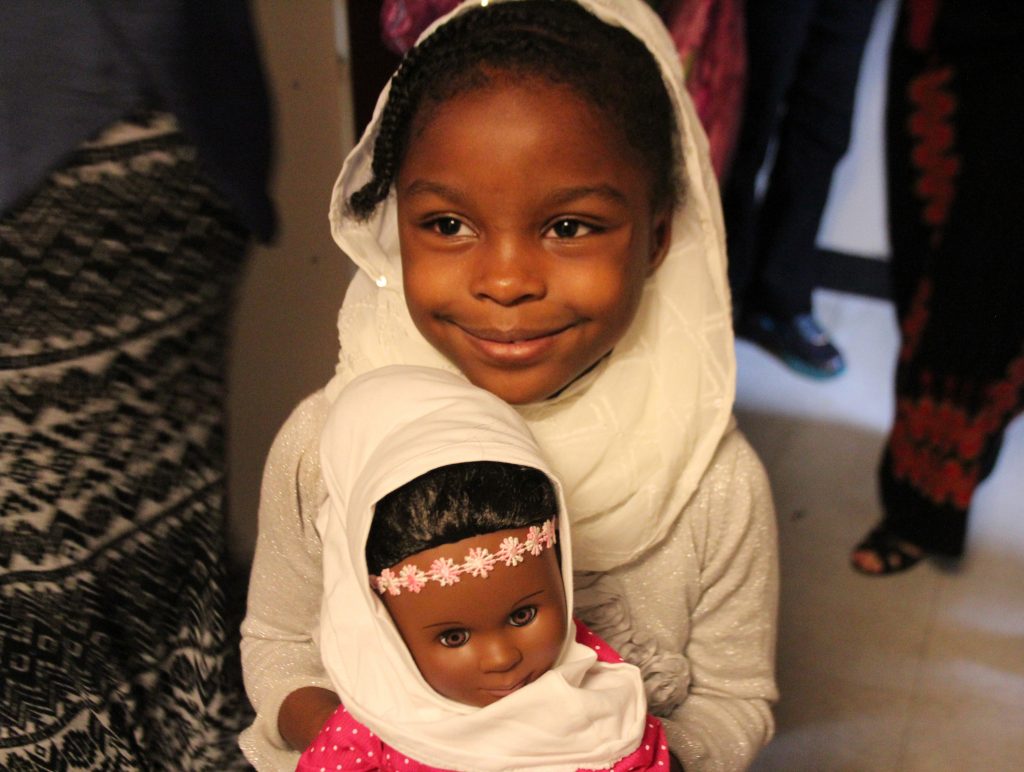
    As she sought to find a way to offer something of value to refugee children, she thought of dolls.  She created the Refugee Doll Project to tell children and their families who make it to the United State that they are welcome here.  And she wanted to raise awareness and appreciation of refugees among long-term residents of the U.S.

    How It Works

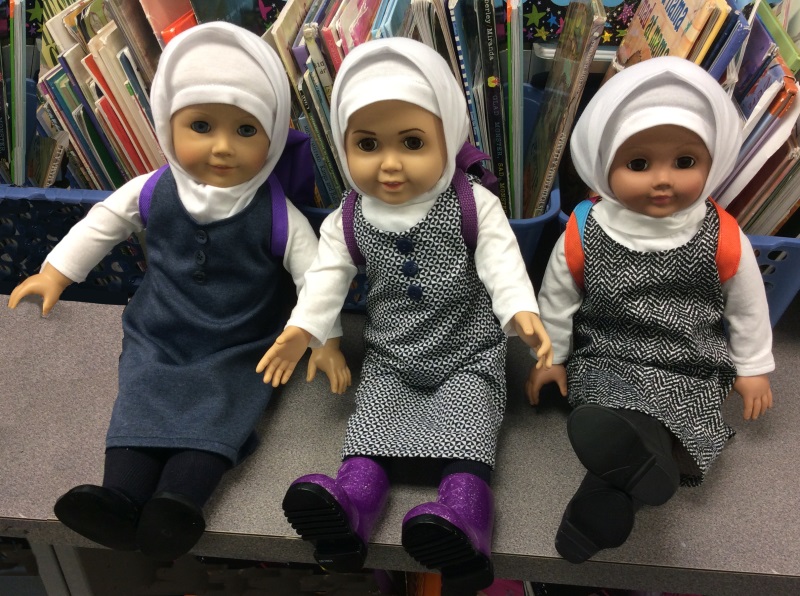
    Jeanne dresses 18″ dolls that she purchases.  She works with Rosalie Croft, a seamstress in Canada best known as Grammie Rose, who sews the dolls’ clothes.   Here’s a link to Grammie Rose’s Doll Clothes. Jeanne selects clothes that children from different cultures might wear to school in the U.S.  I understand Jeanne’s desire to not dress the dolls in traditional outfits.  From talking to newcomer kids of many ages, I often hear that they just want to fit in.  But some kids feel best by naturally dressing in two cultures and Jeanne seeks to capture that desire in her dolls. For instance she has created a doll named Maryam who’s wearing a jumper like a lot of girls might wear to school in the U.S., and also a hijab.

    How to Dress a Doll

    Grammie Rose’s actual patterns are available on the Refugee Doll Project site. Jeanne encourages people to know what countries are most represented by refugees in their own communities and to dress dolls that newcomer children might identify with and see themselves in. Here are Grammie Rose’s patterns and instructions to sew a new refugee doll’s clothes. They include patterns for mid-calf skirts, t-shirts, skull cap, and basic pants for your doll. 

    Books for Your Doll

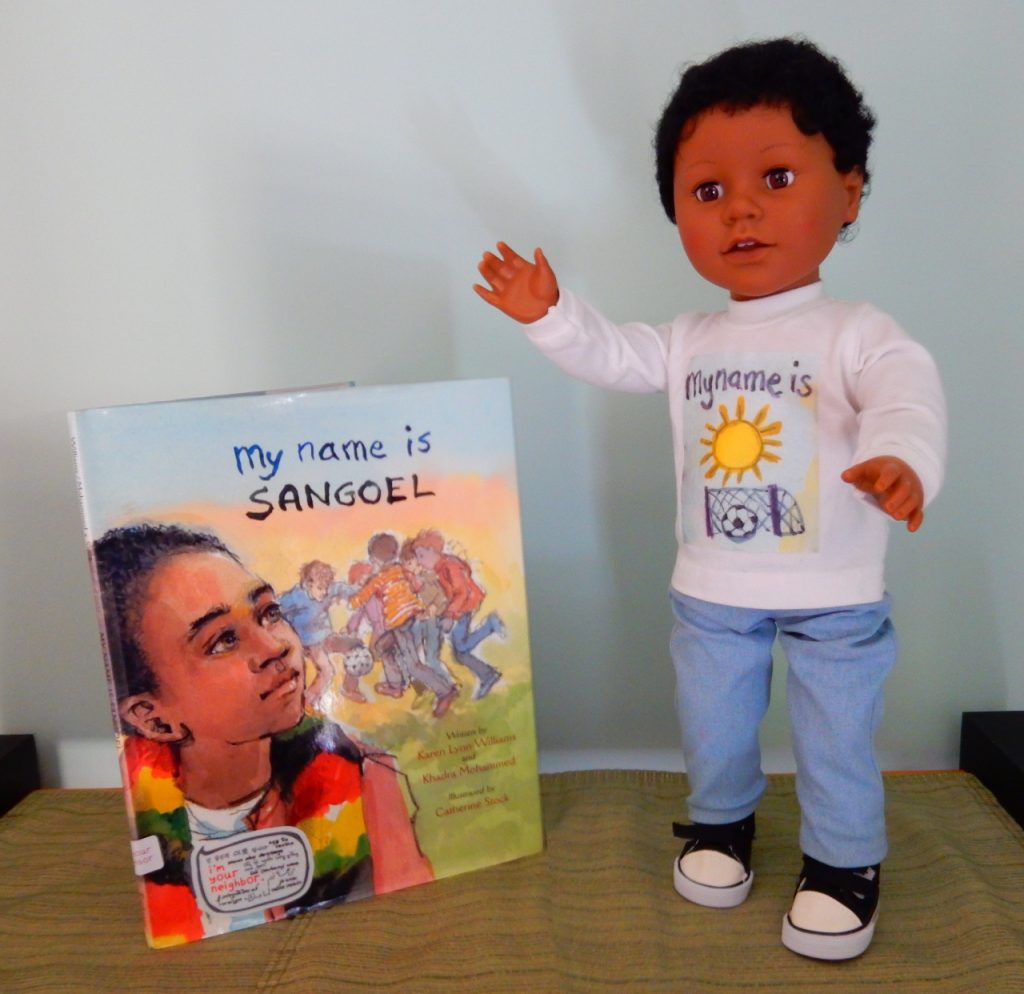
    Maybe the most valuable resource on the site is Books for Your Doll.  Of course dolls need books. Jeanne consulted with Kirsten Cappy and Anne Sibley O’Brien of I’m Your Neighbor Books, an organization that features children’s literature about newcomers to the U.S. and school and community-based activities around books to help people meet each other. Jeanne said,  “Dolls are the symbol [of welcoming].  Books are the heart and soul.” Jeanne has created dolls featuring the characters of some I’m Your Neighbor Books, My Name is Sangoel by Karen Lynn Williams and Khadra Mohammed, Two White Rabbits by Jairo Buitrago and Rafael Yockteng, and My Name is Yoon by Helen Recorvits and Gabi Swiatkowska. In My Name if Yoon, Yoon enters school in the U.S. There she comes to learn she does not have to let go of her beloved name written in Korean to be able also to re-imagine it in her new English language. Jeanne described to me how children read to their dolls in library and school programs. As the children read stories such as Yoon’s to their new dolls, they’ll experience that first imagining of the vast journeys refugees and immigrants take to make a place feel like it could be their home.

  • A School Visit

    I enjoy talking with students about writing and about the content I present in my novels. These photos are from a visit I made in pre-virtual days to St. Paul’s School in Concord, NH.  In discussions with students we explored  issues around my writing of The Good Braider, our role as writers,  and the idea of writing to make a better world as Mary Pipher explores in Writing to Change the World.